

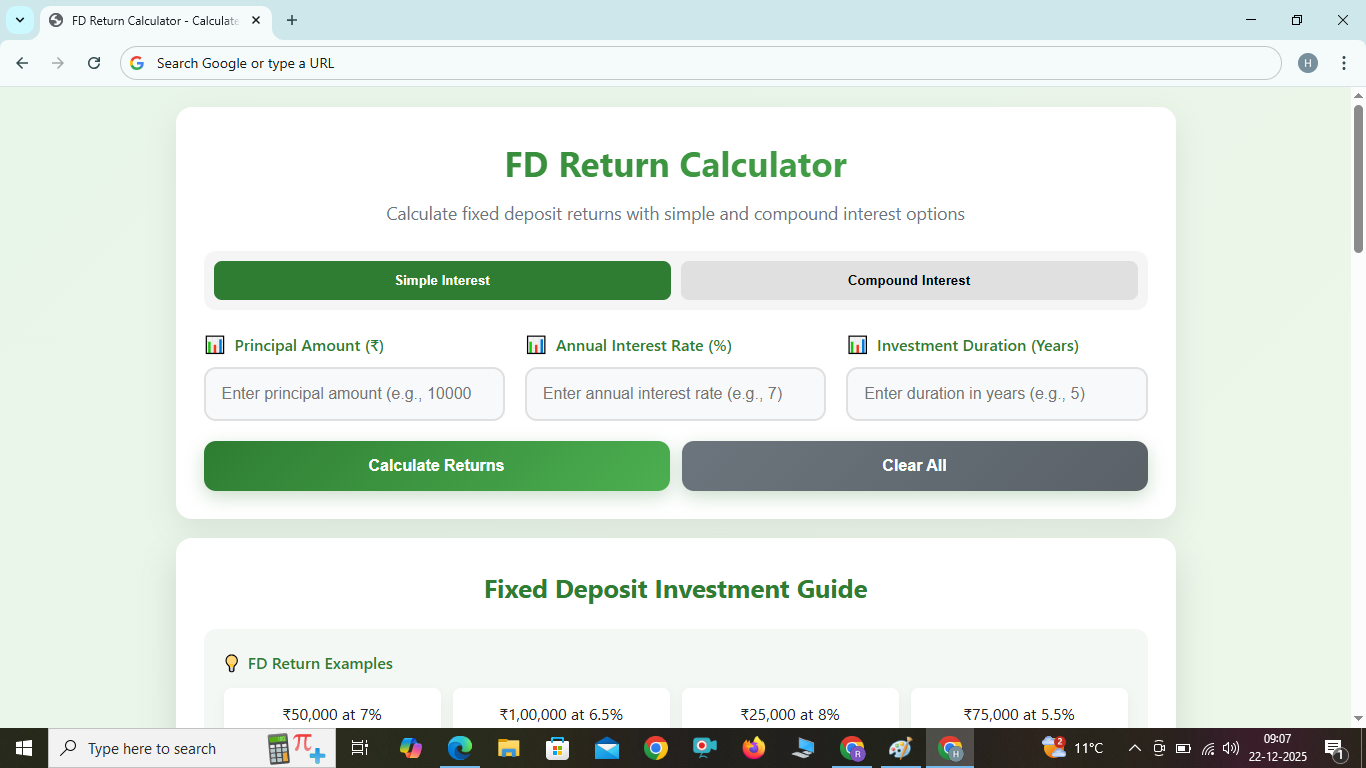
FD Return Calculator
You save ₹1,500.00
FD Return Calculator (wordpress plugin)
Calculate fixed deposit returns with simple and compound interest options
Features of Our FD Calculator
Dual Interest Calculation
Calculate returns using both simple interest and compound interest formulas.
Flexible Compounding Options
Choose from annual, semi-annual, quarterly, or monthly compounding for accurate results.
Visual Investment Breakdown
See pie charts that clearly show your principal amount vs. interest earned.
Growth Visualization
View line charts showing how your investment grows year by year.
Step-by-Step Explanations
Understand exactly how your returns are calculated with detailed steps.
Educational Focus
Perfect for learning about simple vs. compound interest and financial planning.
How to Use This Calculator
Our FD return calculator helps you estimate the maturity value of your fixed deposit with both simple and compound interest options. Here's how to use it:
- Choose interest type: Select between Simple Interest or Compound Interest calculation.
- Enter FD details: Input the principal amount, annual interest rate, and investment duration in years.
- Select compounding frequency (for compound interest): Choose how often interest is compounded (annually, semi-annually, quarterly, or monthly).
- Calculate: Click the "Calculate Returns" button to compute the maturity value of your FD.
- View results: The calculator will display the maturity value along with a detailed breakdown and visual charts.
Frequently Asked Questions (FAQ)
What is the difference between simple and compound interest?
Simple interest is calculated only on the principal amount, while compound interest is calculated on the principal amount plus accumulated interest. Compound interest typically yields higher returns over time due to the "interest on interest" effect.
How is compound interest calculated for FDs?
Compound interest is calculated using the formula: A = P × (1 + r/n)^(n×t), where A is the maturity amount, P is the principal, r is the annual interest rate, n is the compounding frequency, and t is the time in years.
Which is better: simple or compound interest for FDs?
Compound interest is generally better for long-term investments as it allows your money to grow faster due to the compounding effect. Most banks offer compound interest on fixed deposits, which results in higher returns compared to simple interest.
What is the TDS rule for fixed deposits?
Banks deduct TDS (Tax Deducted at Source) at 10% on interest income from FDs if it exceeds ₹40,000 in a financial year (₹50,000 for senior citizens). You can submit Form 15G/15H to avoid TDS deduction if your total income is below the taxable limit.
Can I break my FD before maturity?
Yes, most banks allow premature withdrawal of FDs, but usually with a penalty of 0.5-1% on the interest rate. The exact terms vary by bank and FD scheme.
Are FD returns guaranteed?
Yes, fixed deposits offer guaranteed returns as the interest rate is fixed at the time of investment. However, the actual returns may be affected by taxes and inflation.