

DECIMAL TO PERCENT CONVERTER CALCULATOR
You save ₹1,500.00
DECIMAL TO PERCENT CONVERTER CALCULATOR
(WORDPRESS PLUGIN)
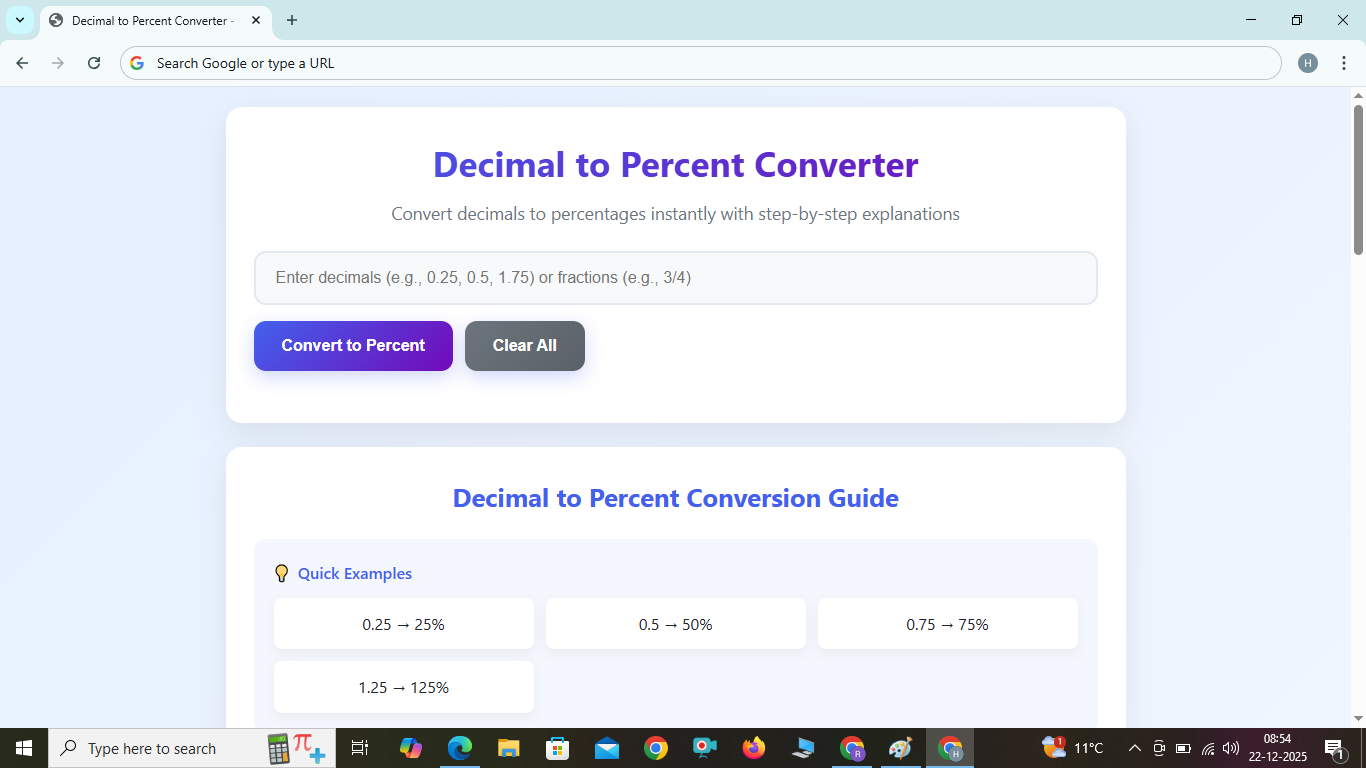
Decimal to Percent Converter
Convert decimals to percentages instantly with step-by-step explanations
Features of Our Decimal to Percent Converter
Multiple Input Support
Convert multiple decimals at once, separated by commas. Supports both decimals and fractions.
Step-by-Step Explanations
See exactly how each conversion is calculated with detailed steps and formulas.
Fraction Support
Automatically converts fractions like 3/4 to decimals before calculating percentages.
Educational Focus
Perfect for students learning about decimals, percentages, and mathematical conversions.
Mobile Responsive
Works perfectly on all devices - desktop, tablet, and mobile.
Free to Use
Completely free with no hidden costs or limitations.
How to Use This Converter
Our decimal to percent converter makes converting decimals to percentages simple and educational. Here's how to use it:
- Enter decimals: In the input field, type the decimals you want to convert, separated by commas (e.g., 0.25, 0.5, 1.75).
- Convert: Click the "Convert to Percent" button to transform all decimals into percentages.
- View results: The calculator will display the percentage equivalents and show detailed step-by-step calculations.
- Learn the process: Review each step to understand exactly how the conversions were performed.
Frequently Asked Questions (FAQ)
How do you convert a decimal to a percentage?
To convert a decimal to a percentage, multiply the decimal by 100 and add the percent symbol (%). For example, 0.25 becomes 0.25 × 100 = 25%.
Why multiply by 100 to convert decimals to percentages?
The word "percent" means "per hundred." So when we convert a decimal to a percent, we're essentially finding how many parts out of 100 the decimal represents. Multiplying by 100 gives us that value.
Can I convert fractions directly to percentages?
Yes! Our converter automatically handles fractions. For example, if you enter "3/4", it will first convert it to 0.75, then multiply by 100 to get 75%.
What about decimals greater than 1?
Decimals greater than 1 convert to percentages greater than 100%. For example, 1.25 becomes 125%, which represents 125 out of 100 or 1.25 times the whole.
How many decimal places should I use?
For most practical purposes, 1-2 decimal places in percentages are sufficient. Our converter shows the exact calculation but rounds to 2 decimal places for the final percentage.
Where is decimal to percent conversion used in real life?
This conversion is used in finance (interest rates), statistics (data analysis), shopping (discounts), education (grading), and many everyday situations where proportions need to be expressed as percentages.